


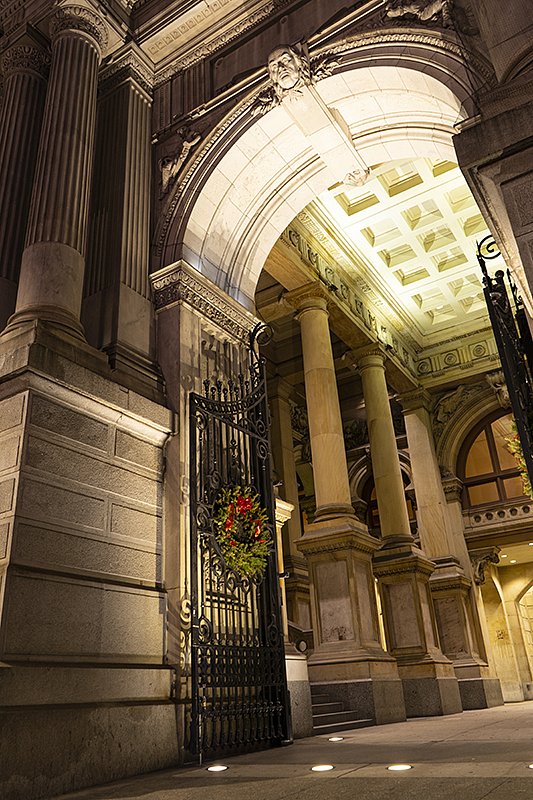
Main gate of Cityhall of Philadelphia
The plans for these gates were actually approved all the way back in 2001, when City Hall’s exterior was in the midst of a huge renovation. The gate’s design was drawn up by the architecture firm Vitetta, but they’re based on sketches made by John McArthur Jr., the original architect of City Hall


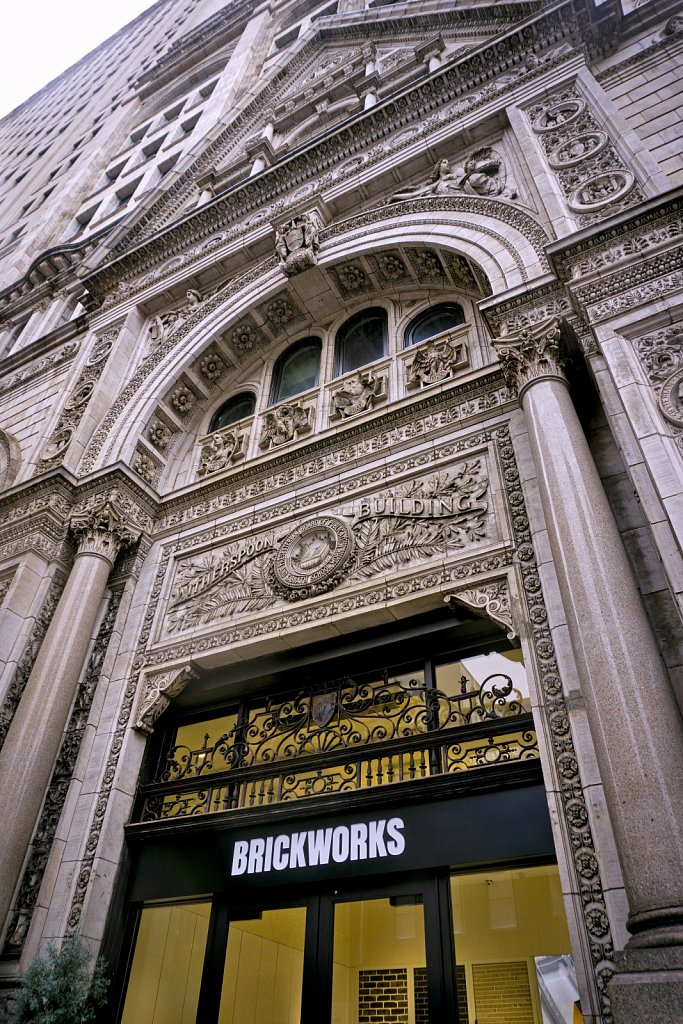
Witherspoon Building
Witherspoon Building is a historic office building located in the Market East neighborhood of Philadelphia, Pennsylvania. It was designed by architect Joseph M. Huston (1866–1940) and built between 1895 and 1897. It was built for the Presbyterian Board of Publications and Sabbath School Work. It is an 11-story, steel frame "E"-shaped building, faced with brick and granite. It has terra cotta decorative elements. Its exterior features Corinthian order and Ionic order columns, statues, medallions, seals of various boards and agencies of the Presbyterian Church and of related Reformed churches. It is named for John Witherspoon (1723–1794), a president of Princeton University.
It was added to the National Register of Historic Places in 1978. (wikipedia)


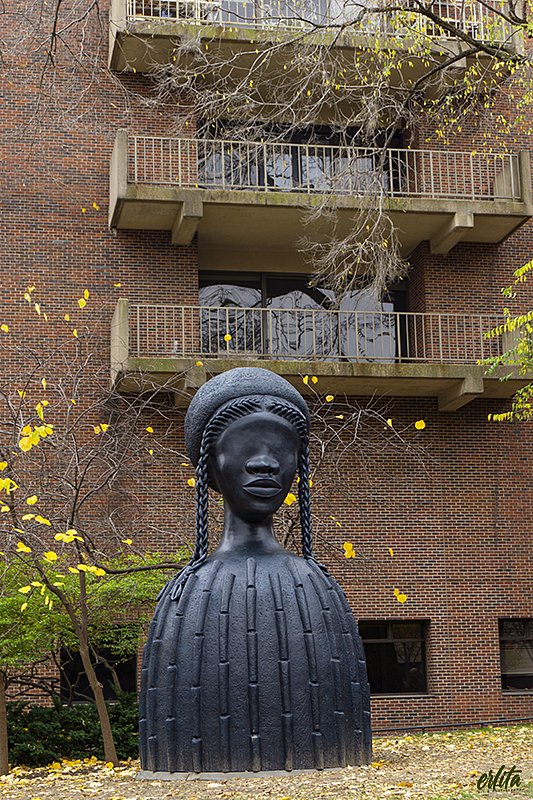
Brick house
A monumental sculpture by acclaimed artist Simone Leigh has been installed at the corner of 34th and Walnut Streets, the gateway to College Green at the University of Pennsylvania.
Titled “Brick House,” the piece depicts a Black woman’s head atop a form that suggests a skirt or perhaps a building. It is the first large-scale piece in the artist’s Anatomy of Architecture series that merges human form with diverse architectural elements. Cast in bronze, the work stands 16 feet high, 9 feet in diameter at its base, and weighs 5,900 pounds. The piece features cowrie shells on the woman’s braids which symbolize wealth, femininity, and the African slave trade in which the shells were used as currency,
The sculpture is a gift from 1987 Penn graduate Glenn Fuhrman, who also earned an MBA degree from The Wharton School the following year, and 1995 Penn graduate Amanda Fuhrman. They advocated for the sculpture's placement on Penn's campus after learning that Leigh hoped to display her artwork on a college campus.


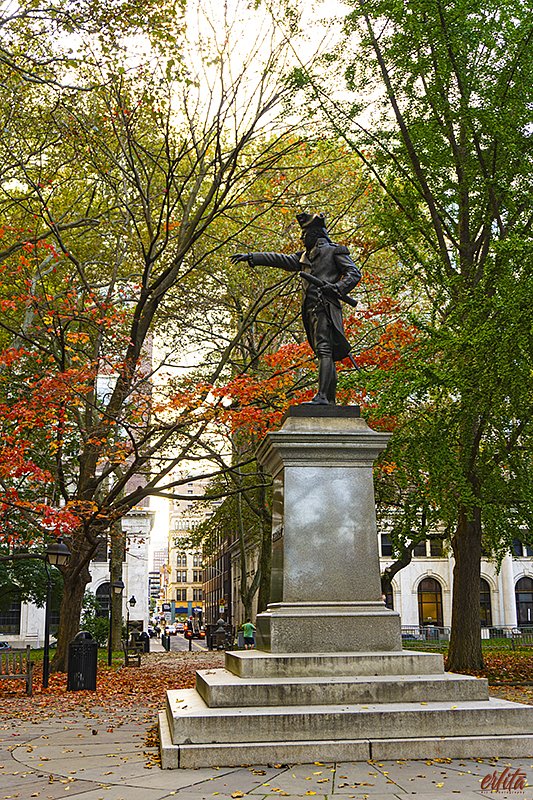
John Barry
John Barry (March 25, 1745 – September 13, 1803) was an Irish-American officer in the Continental Navy during the American Revolutionary War and later in the United States Navy. He has been credited as "The Father of the American Navy" (and shares that moniker with John Paul Jones, and John Adams) and was appointed a captain in the Continental Navy on December 7, 1775. He was the first captain placed in command of a U.S. warship commissioned for service under the Continental flag.
After the war, he became the first commissioned U.S. naval officer, at the rank of commodore, receiving his commission from President George Washington in 1797.
This bronze statue of John Barry (1745-1803) in Independence Square was sculpted by Samuel Murray (1869-1941), the artist who produced the statue of George Washington in front of Independence Hall. The statue was commissioned by the Friendly Sons of St. Patrick of Philadelphia, who then donated the statue to the City. The piece was modeled by Murray, probably in Philadelphia, in 1906. It was cast by the Roman Bronze Works of Brooklyn, NY. The pedestal was built by the Harrison Granite Co. of Barre, VT. A crowd of 15,000 witnessed the unveiling of the statue on March 16, 1907. A number of details are known about Samuel Murray's execution of the sculpture of John Barry. Murray generally worked from life or used photographs or earlier portraits. In both cases, he first modeled a nude figure to establish the anatomy correctly. Before modeling John Barry, Murray studied Gilbert Stuart's painting of Barry and had a friend pose in Barry's own Revolutionary War uniform. George Washington (ca. 1910; north of Independence Hall), Dr. Joseph· Leidy (1907; Academy of Natural Sciences), and-Rev. Corby (1910; Gettysburg battlefield) are other sculptures by Murray.
A few changes were made to the piece shortly after it was dedicated. In 1912, a bronze tablet was added to the north side of the pedestal, as the inscription cut in the stone was illegible from a distance. In 1913, Samuel Murray repaired a finger on the vandalized statue. In 1915, a change in the grading of the base of the statue was approved by the Art Commission.
(wikipedia, nps.gov)


Clothes pin
This steel sculpture was completed in 1976 by Claes Oldenburg. It is designed to appear as a monumental black clothespin. Oldenburg is noted for his attempts to democratize art with large stylized sculptures of everyday objects. Made of Cor-Ten steel, Clothespin is praised by art critics for its velvety texture and weathered, warm reddish-brown color.[3] The silvery steel "spring" part of the two-textured work resembles the numerals "76", apt for the United States Bicentennial year. Tying in Philadelphia's colonial heritage with its difficult present, Clothespin addresses the city's civic issues and tries to bridge gaps across income levels through its universally recognized form. The design has been likened to the "embracing couple" in Constantin Brâncuși's sculpture The Kiss in the Philadelphia Museum of Art.


Architectural sculpturs/objects
Architectural sculptures or objects/elements, either integrated with the structure or freestanding works, they are part of the original design.


It has eyes
It's less what the eye sees and more what the soul feels


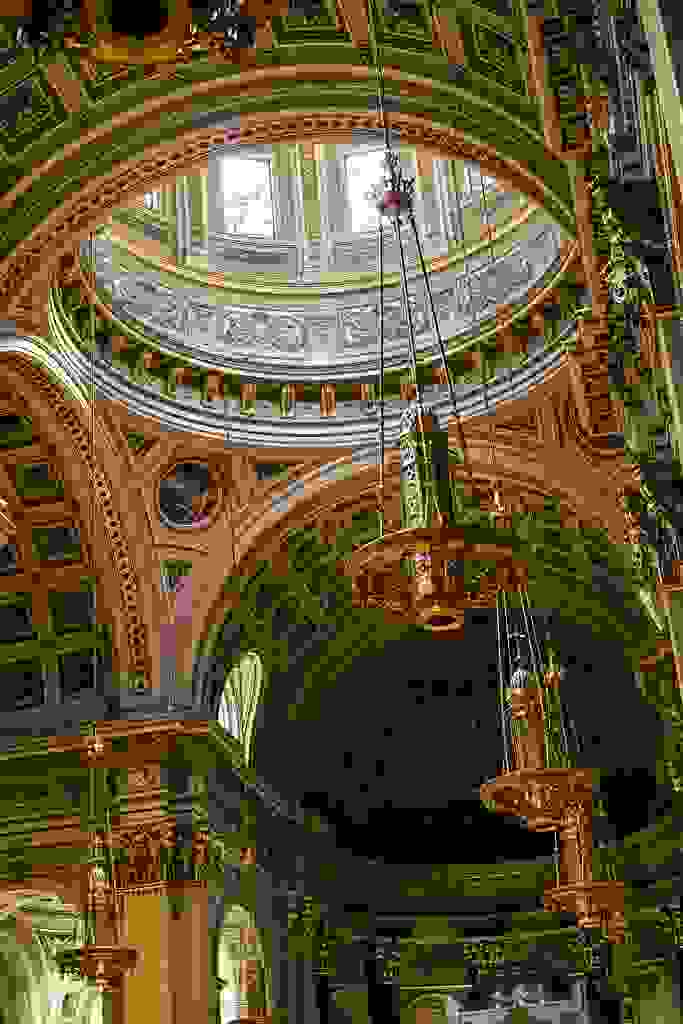
The ceiling of Cathedral Basilica of SS Peter and Paulus
– Natural light is admitted through the clerestory windows close to the ceiling. These are of lightly tinted glass and carry simple religious symbols (IHS (Christ), three lilies representing the Trinity, a key (Saint Peter), a cross, a crown of thorns, a sword and scripture (Saint Paul)) as their most prominent decorations. Gold rosettes on a rich blue background adorn the coffered ceiling. Bronze chandeliers, weighing a half ton each, light the nave. (cathedralphila.org)