


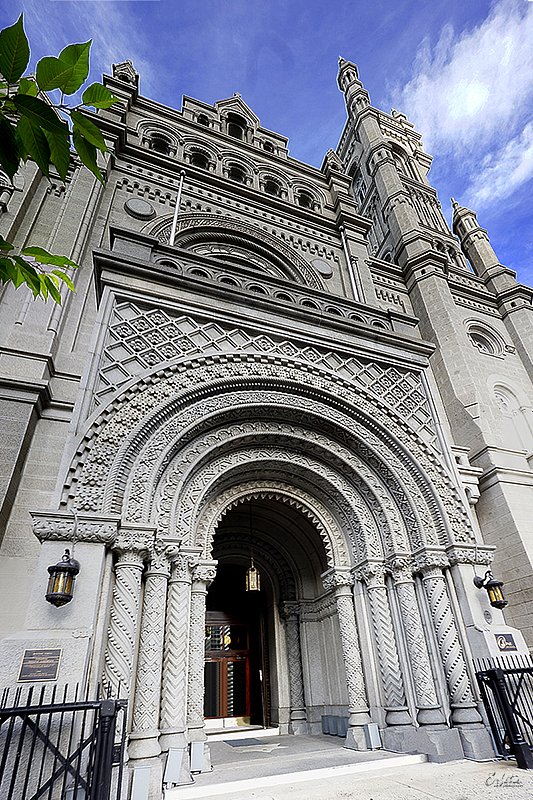
Main entrance of masonic Temple of Philadelphia
The Masonic Temple in Philadelphia was constructed in 1873. It has been called one of the great “wonders” of the Masonic world
The Temple was designed in the medieval Norman style by James H. Windrim, who was 27 years old at the time he won the design competition. The massive granite cornerstone, weighing ten tons, was leveled on St. John the Baptist's Day, June 24, 1868. The ceremonial gavel used on that day by Grand Master Richard Vaux was the same gavel used by President George Washington in leveling the cornerstone of the nation's Capitol building in 1793.
The construction was completed five years later, in 1873. The interior, designed by George Herzog, was begun in 1887 and took another fifteen years to finish.
The bold and elaborate elevations on Broad and Filbert Streets, especially the beautiful portico of Quincy granite, make it one of the great architectural wonders of Philadelphia. The exterior stone of the building on Broad and Filbert Streets is Cape Ann Syenite from Syne in Upper Egypt.
On May 27, 1971, the Temple was listed on the National Register of Historic Places. It was designated a National Historic Landmark in 1985. It was cited in its landmark designation as one of the nation's most elaborate examples of Masonic architecture.